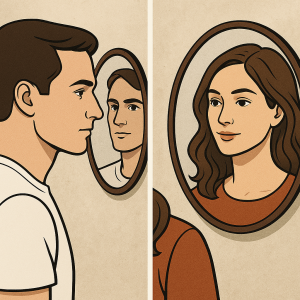

A while back, I blogged about this very question: Who Am I? From a yoga perspective and my own personal experience, I recognize the importance of re-evaluating my understanding of who I am on an ongoing basis. Given that change is the constant in our lives, it goes without saying that we are experiencing internal and external change minute-to-minute, day-to-day, and year-to-year. Becoming aware of these changes as rising sensations in the body, and emotions and thoughts in the mind, is yoga’s way of teaching self-realization.
To illustrate this point, my previous blog focused on identifying our egos as illusory aspects of who we are. In part, this discovery that the ego is more about conditioning and fear than reality and nobility enabled me to evolve my sense of self from “a human being on a spiritual journey” to “a spiritual being on a human journey”. Accepting that my capacity to respond nobly to life’s events is innate and trustworthy took faith and repeated practice. Ultimately, we are both spirit and human. Integrating both aspects into who we are is our lifelong journey and adventure.
In our human growth, the alphabet soup of identity has taken on many forms:
- from a gender expansive perspective — LGBPTTQQIIAA+ for lesbian, gay, bisexual, pansexual, transgender, transsexual, queer, questioning, intersex, intergender, asexual, ally, and more.
Note: Neurocomplexity/creativity intends to foster universal or national unity. - from an astrological archetypal perspective — Hero (Champion, Lover, Healer, Servant, Partner, Alchemist, Explorer, Mentor, Truth Teller, Mystic) versus Villain (Egotist, Self-Indulger, Trickster, Manipulator, Dictator, Martyr, Avoider, Destroyer, Fool, Hermit, Fanatic, Escapist)
Note: An archetype is a mental model or universal pattern of behaviour intended to help us better understand ourselves and others. Plato believed archetypes were pure mental forms imprinted in the soul before our birth. Psychologist Carl Jung described them as universal patterns of thought present in an individual’s unconscious and inherited from humanity’s past collective experience. Archetypes’ quintessential nature generalizes across age, race, religion, gender, education, and profession. - from a gut (instinct), heart (feelings), or head (intellect) Enneagram perspective — Gut (Challenger, Peacemaker, Perfectionist), Heart (Helper, Performer, Romantic), Head (Investigator, Loyalist, Enthusiast).
Note: Although we may use all three centres, each of us “habitually prefers one” centre (doing, feeling, or thinking) for taking in information or encountering new situations. - from a yoga Dosha perspective — Vata, Pitta, Kapha.
Note: We are born in a perfect state of balance, but as life unfolds, we may find ourselves out of balance. Knowing your dosha type allows you to assess what and where the imbalance is and how to regain calm abiding and clear seeing. To return to balance is to live with meaning, health, and happiness in the dosha combination that is your birthright.
The Vata dosha body type is always on the go. Movement and change predominate for this energetic, creative mind and lean body. An imbalanced vata dosha expresses in the body as weight loss, constipation, arthritis, restlessness, and digestive challenges.
The Pitta dosha is our digestive fire, responsible for body temperature, metabolism, and physical suppleness. Too much pitta results in excess hunger and thirst and minimal sleep along with other fiery symptoms.
The Kapha dosha governs the body’s structure (cells, muscles, bones, fat, sinew). Kaphas are slow, steady, and solid with naturally calm and loving constitutions. In excess, kapha manifests in weight gain, fluid retention, allergies, and depression.
Although the above list is limited to four classification systems, there are many more. No doubt you have your own favourite. So, what learning are we to take from the increasingly complex arena of identity? Self-knowledge/realization is a lifelong process? Who we ‘humanly’ are in the present moment changes/evolves? Identity is not permanent? All of these are true.
The yoga teaching I find most helpful in furthering my own growth and understanding is to embrace the part of me that is unchanging — my spirit or essence. For me, this choice empowers calm abiding and clear seeing, releasing me from the trap of conditioned habitual reactions such as the pursuit of pleasure and avoidance of pain. Simply stated, yoga’s journey into the joy of our “bliss” body is who we are now and forever.
For more yoga actions and teachings, click here. Namaste.