Over the millennia, yoga has absorbed wisdom from other belief systems, namely Buddhism. One such teaching, called shenpa, reflects our human “knee-jerk pattern of moving away from being present”*1. Each of us has our personal triggers that kick us into escaping the present and send us down the paths of attachment or aversion. The feeling of tightening within and then defensively exploding out when our insecurities are triggered aptly describes the shenpa experience. As Pema Chodron writes, “My mind and heart are closed. I’m so invested in my views and opinions that those who think differently are my adversaries. I become a fundamentalist: one who feels strongly that I am right and who closes my mind to those who think otherwise.”
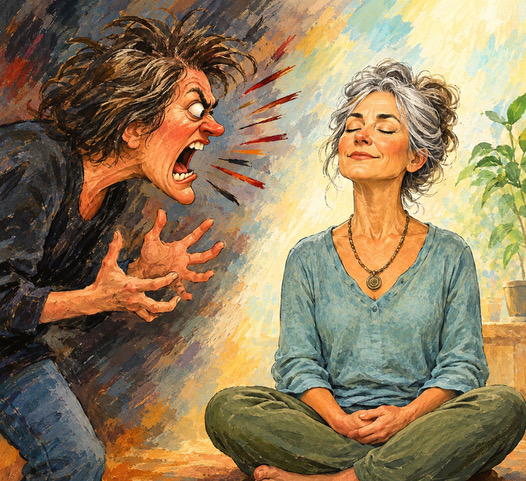
When I study a new way of being, such as that above, I’m always struck by how Life immediately provides me with exactly the experience I need for greater understanding. Yesterday, I was bicycling across Osborne Bridge on its pedestrian sidewalk. The bridge has a very narrow bike path on the roadway, which puts cyclists directly alongside vehicles traveling 60 kilometers an hour. On a side note, three years ago, I was hit by a moving car in a pedestrian crosswalk. This was not the only reason I became a committed sidewalk cyclist. At 72, I don’t feel I can compete with the rushing road traffic. About once a year, on this same bridge, someone confronts me with their shenpa — “You are not supposed to be on the bridge”, “I don’t care what age you are”, “That’s the rule”, etc., etc. Typically, s/he holds their arms out so I cannot pass them and continues to berate until their traveling companion moves out of the way to let me pass. As you read these words, some of you may already feel a tightening in your being and also want to tell me to get off the sidewalk. This is your shenpa calling to you — the need for control and to do what is perceived as right.
I don’t want to leave you hanging there. You are not alone. My shenpa is triggered when others try to control me with their beliefs about right or wrong. So there we were. Him yelling at me and preventing me from getting past him, me watching the tightening in myself and managing to not say the usual comebacks I often hear when I witness this situation with others — “*?/ you!”, “Mind your own business”, “Someone got up on the wrong side of the bed this morning, etc, etc.
So, what is the solution when shenpa prevails on both sides of the conversation? Both Buddhism and Yoga offer the following formula — Sit, Stay, Heal.
Sit in the insecurity and discomfort of being triggered, of not being in control, not knowing what’s coming, not being able to fix it.
Stay present in the uneasiness, become very familiar with it, and experience your natural intelligence eventually emerging.
Heal yourself and others from this place of wise compassion and fearlessness.
Sitting and staying allow us to witness our urge to react defensively as well as our capacity to not act out or repress our feelings. In the past, I would ignore the enraged outbursts and say nothing, but that did not feel as though I was adding to anyone’s healing. Instead, yesterday, I commented to the pedestrian, “You live by rules, and I do not.” My tone was without judgment. It stated just what was real. In speaking it, I realize the other person probably could not hear it as truth, nor was I bringing us into a state of healing. It was the “cleanest” statement I could make at the time. In other words, I did the best I could given the understanding, skills, and wisdom I currently have. More to learn. Chodron aptly puts it as,
When we are not blinded by the intensity of our emotions, when we allow a bit of space, a chance for a gap, when we pause, we naturally know what to do. We begin, due to our own wisdom, to move toward letting go and fearlessness. Due to our own wisdom, we gradually stop strengthening habits that only bring more pain to the world.
And, I say Hurrah to that.
*Resources:
1. Chodron, Pema. (1997) When Things Fall Apart: Heart Advice for Difficult Times, Shambhala Classics.
For more yoga actions and teachings, click here. Namaste.