Worry wastes time.
Mind spins endlessly
through past or future
never resting in the present.
The Tao and Yoga, as foundational concepts in East Asian philosophy and religion, share several core tenets.
Tao (or Dao) literally means “the way” or “the path.” It represents the unconditional, ineffable source of the universe and the natural, harmonious process by which all things change.
Tao’s Core Philosophy
- The Unnamable Source: As described in the foundational text, the Tao Te Ching, the eternal Tao cannot be fully captured in words. It is the formless void from which all existence flows.
- Natural Harmony (Wu Wei): A core practice is Wu Wei, often translated as “non-action” or “effortless flow.” It advocates aligning your actions with the natural rhythm of the universe rather than fighting against it with ego, forced ambition, or unnatural resistance.
Key Dimensions of Wu Wei
1) Effortless Action: the state of doing only what is required without friction or forcing an outcome. Often compared to being “in the zone,” where skill and awareness seamlessly unite.
2) Actionless Action: a paradox implying that while an individual takes action, the action is so aligned with natural principles (the Tao) that it feels as natural as water flowing around a rock.
3) Letting Go of Control: involves abandoning rigid ideals, overthinking, and stubborn ego-driven plans, allowing situations to unfold naturally and you to respond intuitively. - Yin and Yang: The Tao encompasses the balance of opposing forces in nature (e.g., light and dark, active and passive), highlighting that these dualities are interconnected and essential for balance.
As an eight-limb path of balanced wholistic experience, yoga also promotes effortless flow, alignment, surrender to universal forces, and intuition as a wise decision-making guide.
Both Yoga and Tao philosophies and tools are designed to counteract the conditioned pattern of worry so rampant in today’s world. These two belief systems hold that worry, when maintained, concretizes into tension and then disease — stress, anxiety, depression, heart failure, cancers, digestive disorders, etc. Deng Ming-Dao, in 365 Tao, wrote, “worry is not useful. It is a cancer of the emotions–concern gone compulsive. It eats away at body and mind.” In effect, both Yoga and Tao view worry as an addiction. The good news is that addictive behaviour can be changed.
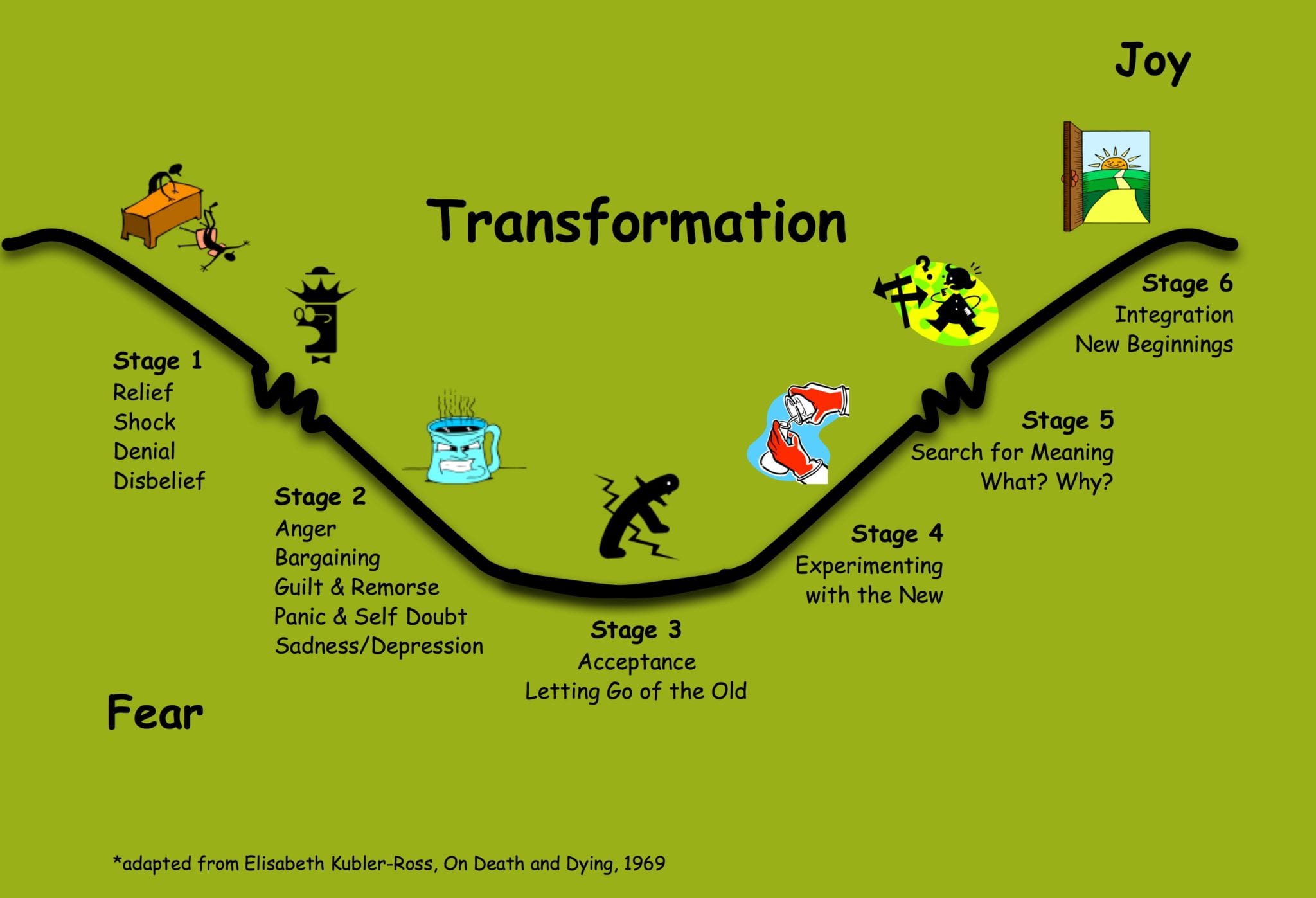
When I consider changing one of my own addictive habits, I often find myself returning to Elizabeth Kübler-Ross’s Change Curve. Her psychological framework maps the emotional journey we experience when faced with significant disruption or transition — job loss, divorce, death, disease, etc. Within its stages, there is an initial drop in morale and confidence before climbing back up.
Stage 1. The Descending Phase (Resistance)
- Shock: The initial reaction of surprise, disbelief, or numbness when the change is announced.
- Denial: Ignoring, clinging to the status quo, or assuming things will go back to normal.
- Anger: Frustration and resentment set in as the reality. Blame may be directed outward.
Stage 2. The Lowest Point (the Ditch of Doubt & Worry)
- Bargaining: trying to negotiate compromises to minimize the impact (e.g., “If I do X, maybe I don’t have to change”).
- Depression: feelings of overwhelm, powerlessness, or decreased motivation as the loss of the old way is fully realized.
Stage 3. The Ascending Phase (Acceptance & Growth)
- Acceptance: Giving up resistance, accepting that the change is inevitable, and improving morale.
- Integration / Experimentation: proactive engagement with the change, problem-solving, and exploring new ways of being.
- Commitment / Growth: The change is fully adopted — individual adaptation to the “new normal”.
Because all addictions block one’s ability to be compassionate and act from a place of loving kindness, it is vital to keep walking one’s spiritual path and to focus on changing what you have control over — yourself.
In a recent yoga sangha discussion on this topic, here are some practices my own community relies on.
- Keep doing the “work” or, in other words, double down on those practices that keep you centred in the present moment and in your truth.
- Meditate on and rest in your centre of gravity (lower pelvic area).
- Spend time in your community of “faith”.
- Maintain intimate (in-to-me-see) relationships with loving and kind people.
- Replace judgment and worry with asking questions and listening for answers.
- Affirm that the learning and growth you bring forth in yourself energetically expand tenfold into the world.
- Trust that the universe is here to provide for and protect you at all times.
I trust the Universe to take care of me, and I release all control to it.
I am at peace with myself and with all of life.
Louise Hay
For more yoga actions and teachings, click here. Namaste.