7 Tension Bands or Straps:
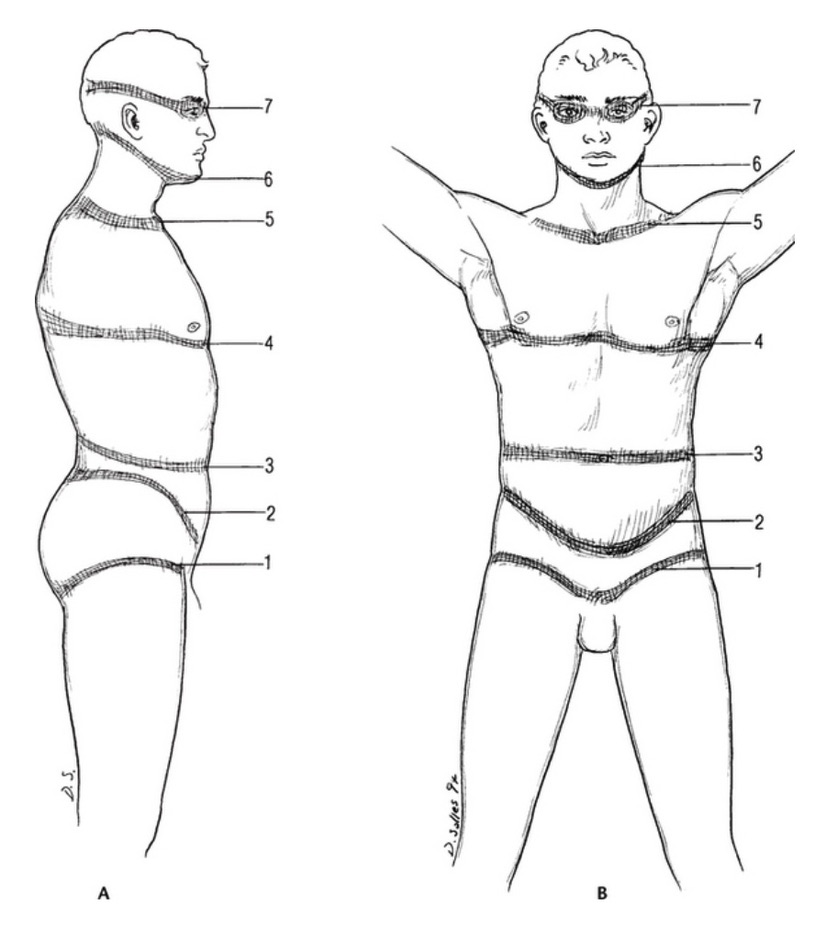
- Pubic Bone 2. Inguinal 3. Navel 4. Diaphragm 5. Collar Bone 6. Jaw 7. Eye
Myofascia is the flexible network of tissue that surrounds, cushions, and supports muscles, bones, and organs. It acts as a riverbed containing the flow of interstitial fluid. Interstitial fluid fills the spaces between cells and tissues in the body, accounting for 26% of total body water. It is crucial for transporting nutrients (oxygen, glucose, amino acids) from blood capillaries to cells and for removing waste products.
The flexibility of our myofascia is so critical to our overall health and well-being that two lineages of yoga asana – Yin and Kaiut – are designed to open and purify myofascial anatomy. More specifically, two Rolfing practitioners authored, The Endless Web, which emerged from 20 years of their research and practice in understanding and working effectively with the myofascial system. To summarize, their findings:
- As a result of daily living, most human bodies develop seven tension bands or straps. These locations are where we primarily hold our unresolved emotions as tension. Over time, these ‘unnatural’ bands can concretize. Depending on the individual’s personal choices and experiences, some bands are likely to be tighter than others.
Liken these bands to the armour of an armadillo. Each band’s seeming purpose is to preserve our internal structure as we bend and move. If left to live this false purpose, the bands become tighter, not unlike a tightening noose. The evolving pressure cuts off blood capillary circulation. - Without a deeper awareness of these tension bands, our daily or even weekly asana practice can contribute to further concretization. To dissolve the concretized connective tissue bands, we need to find subtle ways, rather than muscular-skeletal, to penetrate the tension.
NOTE: The seven connective tissue bands are unnatural straps holding tension just under the skin’s surface. Unattended, this tension continues to move inward toward the inner layer of fascia surrounding the organic system. Stretching does not penetrate and open the circulatory system. Instead, we have to hydrate each band with our awareness.
Strap 1 – PUBIC BONE: runs from the tailbone-sacral joint around the outer trochanters and upper thighs and along the sides of the pubic bone. 1st CHAKRA
Strap 2 – INGUINAL: runs from the sacral-lumbar joint along the front edges of the hips to above the centre of the pubic bone. 2nd CHAKRA
Strap 3 – NAVEL: runs from the lumbar-thoracic joint around the waist to the navel (above or below). 3rd CHAKRA
Strap 4 – DIAPHRAGM: runs from the DORSAL thoracic hinge around the rib cage to the bottom of the sternum (xyphoid process). 4th CHAKRA
Strap 5 – COLLAR BONE: runs from the lumbar-C7 joint along the upper shoulder blades through the shoulder joints to continue along the collar bones. 5th CHAKRA
Strap 6 – JAW: runs from the apex vertebra to below the lower ears and along the jaw line.
Strap 7 – EYE: runs from the occipital joint above the upper ears to around the eyes. 6th CHAKRA
The following subtle Yoga Actions will open and hydrate the seven tension bands.
YOGA ACTIONS:
- Use your awareness to track along the full circumference of each band/strap.
- Start by sensing the space between each of the major spinal joints and then track around to the front connection.
- Notice any blockages/numbness/sensations.
Melting these tension straps requires a gentle, patient approach. Not unlike the yearly Spring thaw, if you melt them too quickly, you will flood and overload your nervous system. Typically, an overwhelmed nervous system reacts from fight-flight-freeze rather than rest-digest. Healing does not occur when we are locked into our Sympathetic Nervous System because all our energy is channeled into survival. Healing and purification can only take place when we shift into our Parasympathetic Nervous System’s rest-and-digest response.
Begin with a highly restorative pose such as Supta Baddha Konasana. Spend 10 to 15 minutes just familiarizing yourself with each band in your own body. Use the Yoga Actions to increase your awareness and begin the subtle, gradual melting process.
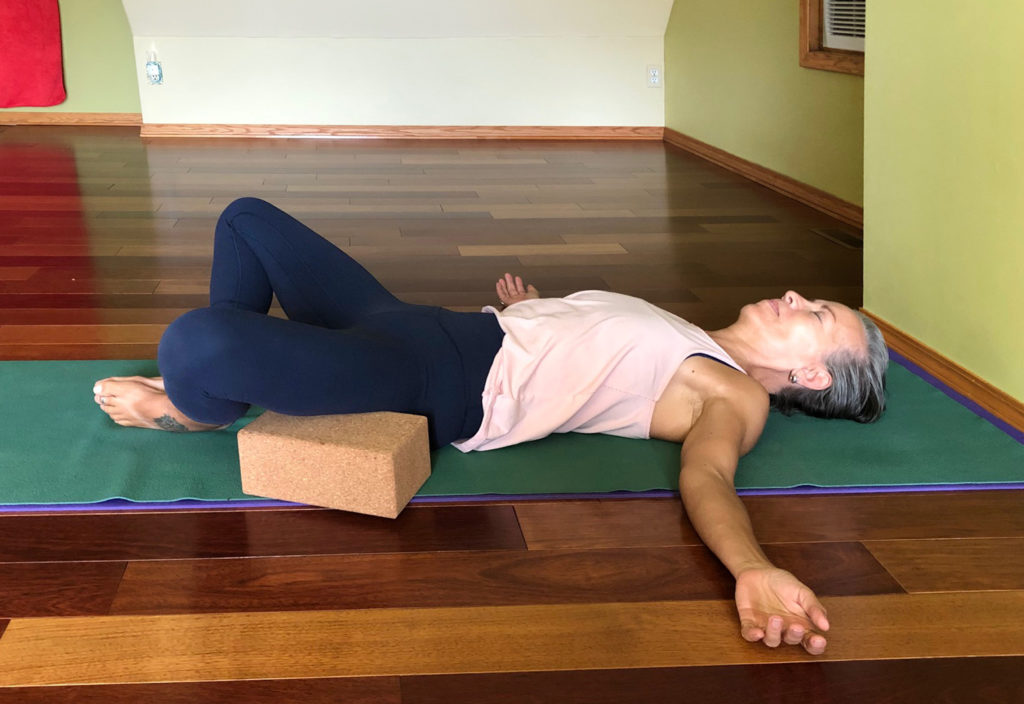
SUPTA BADDHA KONASANA
As you introduce more postures, continue using the Yoga Actions to identify your more predominant bands. As sensations show up in each pose, can you connect the sensations to a specific band? Go slowly, adopt a loving kindness attitude, and back off to experience ease.
Source: Louis Schultz, Ph.D., et. al., (1996) The Endless Web: Fascial Anatomy & Physical Reality.
For more yoga actions and teachings, click here. Namaste.