I just returned home from facilitating a workshop in which participants Crafted their Soul’s Portrait. Their guiding focus for completing this task was to answer the question, “Who am I?” In initial attempts to answer this question, the tendency is to respond with “What I Do” by emphasizing roles we have played — daughter/son, husband/wife, mother/father, athlete, lawyer, teacher, etc. Yoga teaches us that our thoughts, words and actions are not our true self.
When we begin our yoga journey, the language we might hear from others or use to describe ourselves and our experiences is – “I’m a human being on a spiritual journey.” Our primary identity is with our physical body and mental-emotional functions. As our yoga practice and our self-awareness deepen, how we identify ourselves might begin to change into – “I’m a spiritual being on a human journey.” Our primary identity shifts toward our true Self or spiritual essence. With increased integration of our Annamaya (physical body), Pranamaya (energetic body), and Manomaya (mental-emotional body) Koshas, the ability to experience and live from our Vijnanamaya (intuitive/wisdom body) and Anandamaya (bliss/spirit body) increases.
Shifting our identification from physical to spiritual accompanies a growing capacity to see through outer illusions and inner delusions. Peeling back these cloudy layers not only reveals who we are but also serves to uncover the truth, joy, and love awaiting us within.
In my own personal experience, major crossroads in my life required me to repeatedly ask “Who am I?” And as I entered my elder years, yet another crossroad appeared. As Eknath Easwaran aptly writes in The Upanishads,
Nothing places the question “Who am I?” in such stark relief as the fact of death. What dies? What is left?
Are we here merely to be torn away from everyone, and everyone from us? And what, if anything, can we do about death – now, while we are still alive?
So many questions at once can appear overwhelming. However, verses 1-2 of the Katha Upanishad below shine a light on a possible direction forward.
1 The joy of the spirit ever abides,
But not what seems pleasant to the senses.
Both these, differing in their purpose, prompt
Us to action. All is well for those who choose
The joy of the spirit, but they miss
The goal of life who prefer the pleasant.
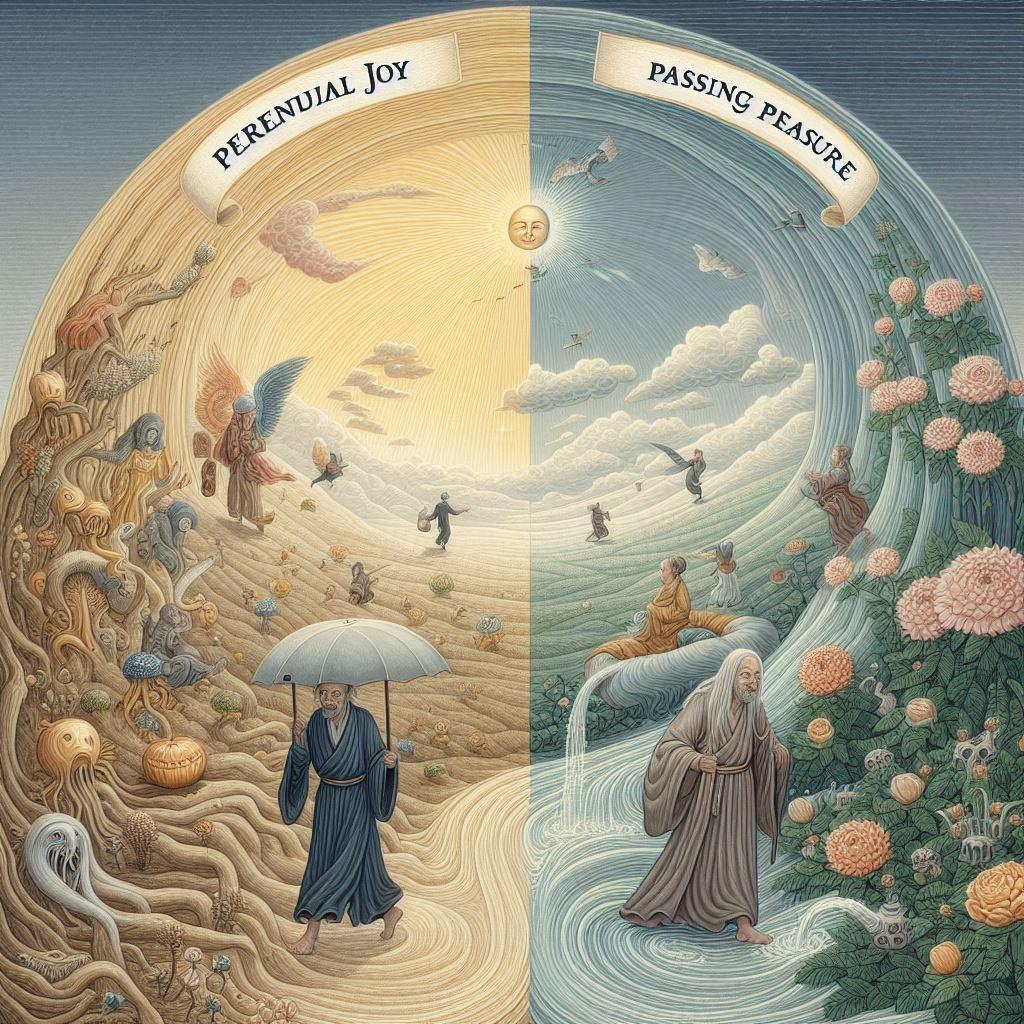
2 Perennial joy or passing pleasure?
This is the choice one is to make always.
Those who are wise recognize this, but not
The ignorant. The first welcome what leads
To abiding joy, though painful at the time.
The latter run, goaded by their senses,
After what seems immediate pleasure.
These verses simplify our choice of paths — perennial joy or passing pleasure. An example of “passing pleasure” is the sensory pursuit of instant gratification. Immediate gratification is the desire to choose smaller, immediate rewards over larger, delayed ones. However, seeking instant pleasure and satisfaction can lead to impulsive behaviors like choosing fast food over a healthy meal or procrastinating on important tasks to do something more entertaining or even distracting oneself to avoid conflict. Reinforcing impulsive behaviour further blocks our capacity to respond intuitively from our wisdom body. Staying on the pleasure path perpetuates a constant pursuit of new rewards because their impermanence is short-lived. Finally, research on happiness continually reveals that nothing in the outside world brings lasting happiness — that emotional state characterized by feelings of joy, satisfaction, contentment, and fulfillment.
Joy is truly an “inside job.” It and its accompanying kin — love, contentment, and fulfillment — are steadily revealed to us as our self-awareness grows. In the early days of awakening to spirit, we catch “glimpses” of these joy-filled moments. These blissful moments expand along with our expanding essence, and we discover that nothing and no one can take away our joy. It is that aspect of who we are that is permanent. This discovery leads us beyond “Who am I” into What dies? What is left? And what, if anything, can we do about death – now, while we are still alive?
Parmahansa Yogananda, familiarly titled the “Father of Yoga in the West,” offers this for your consideration,
Now, after observing faces that register pleasure, sorrow, boredom or temporary peace, wouldn’t you rather that your face reflect the contagious ever new joy of Spirit?
To be able to do this you must drink and drink bliss from the cask of deep meditation until you become a bliss alcoholic, manifesting bliss in sleep, dreams, wakefulness, and all circumstances of life that might otherwise tend to make you boisterously happy, or abysmally sad, or saturated with boredom or temporary negative peace.
For more yoga actions and teachings, click here. Namaste.