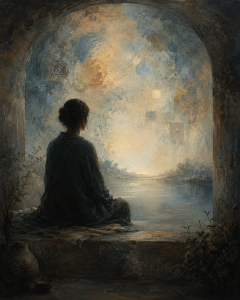
The word ‘Upanishad’ is supposed to connote a secret instruction or a hidden doctrine, secret and hidden in the sense that it purports to reveal the invisible background or reality behind the visible forms of temporal existence. It is evident that things are not what they seem. And the Upanishad is a record of the unfolding of the mystery that lies behind phenomena. Swami Krishnananda
The Upanishads are a grouping of over 100-200 ancient philosophical-religious texts meant to aid a wisdom seeker along her/his path to self-realization. Generally, the 13 Upanishads listed below are the most commonly studied by those seeking spiritual truth.
- Brhadaranyaka Upanishad
- Chandogya Upanishad
- Taittiriya Upanishad
- Aitareya Upanishad
- Kausitaki Upanishad
- Kena Upanishad
- Katha Upanishad
- Isha Upanishad
- Svetasvatara Upanishad
- Mundaka Upanishad
- Prashna Upanishad
- Maitri Upanishad
- Mandukya Upanishad
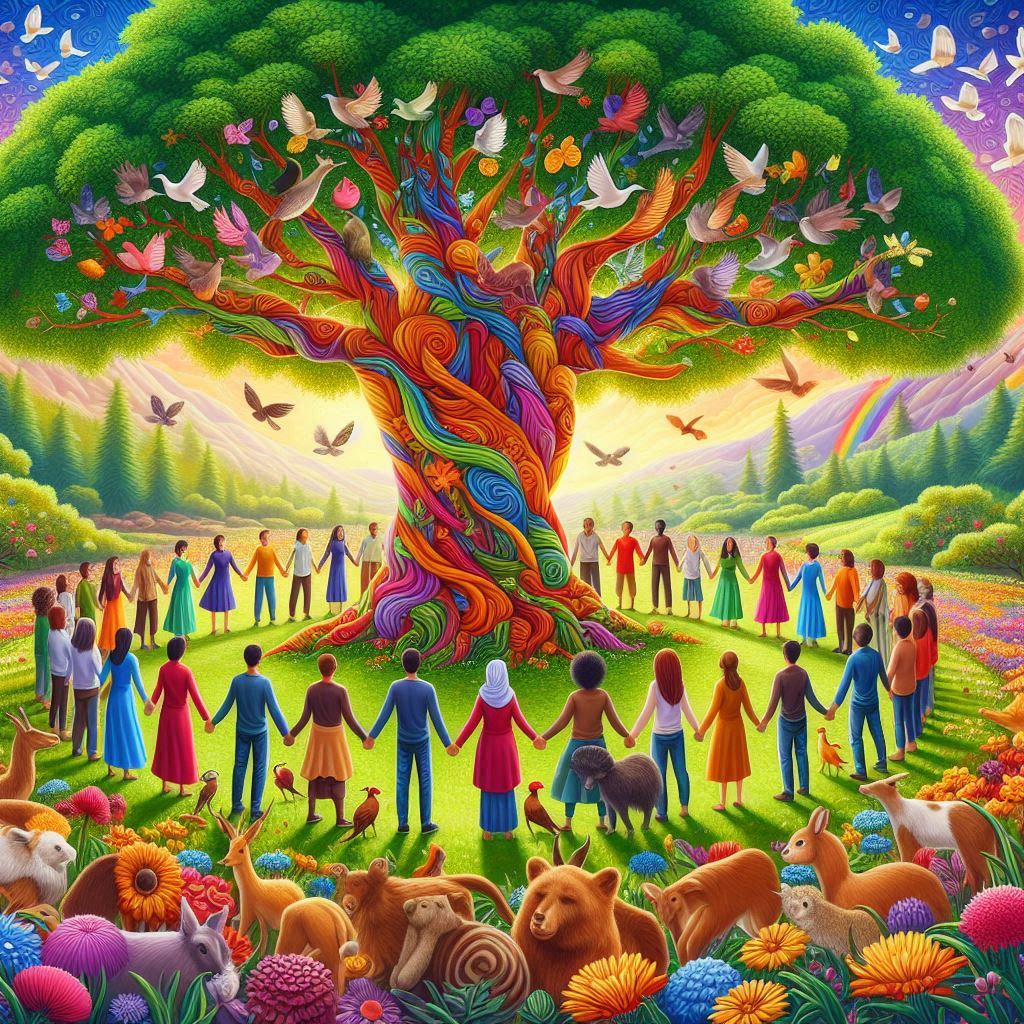
The Isha Upanishad focuses on unity and the illusion of duality. It’s major thrust is on the importance of recognizing the unity of all existence and the folly of believing one’s self to be alone in the world. This concept is expressed in verses 6 and 7:
Those who see all creatures in themselves
And themselves in all creatures know no fear.
Those who see all creatures in themselves
And themselves in all creatures know no grief.
How can the multiplicity of life
Delude the one who sees its unity?
These two verses from the Isha teach that a person who recognizes the underlying unity of all life cannot be deluded by its outward multiplicity. However, if this unity or oneness is not recognized, then the perceived separation of “self” from “other” is the root cause of fear and grief. In other words, when that perceived separation is gone and we see ourselves in all beings and all beings in us, we are freed from illusion. This self-realization leads to a state of being where concepts like fear, grief, jealousy, and hatred are no longer experienced.
The primary elements of this verse emphasize …
- Unity over multiplicity: The core idea is that “all creatures” are not truly separate but are manifestations of a single, underlying reality. Thus, the individual is not a distinct, isolated entity but is connected to everything else.
- Elimination of fear and grief: Fear and grief arise from the perception of a separate self that can be harmed, lost, or divorced from what it desires. By seeing and experiencing the self in all, this sense of separation dissolves, eliminating the basis for fear and grief.
- Transcendence of duality: The final phrase of this verse “How can the multiplicity of life delude the one who sees its unity?” is a rhetorical question. It implies that the “delusion” of multiplicity is only possible when one fails to see the unity. The wise person is not fooled because they perceive the deeper, unified truth, not the superficial differences.
Unity is a challenging belief for a humanity living amidst warring nations and climate change. However, as the Earth continues to show us how its degradation has consequences for the well-being of all existence, we may be approaching the recognition that “we are all one, and to harm one harms all.” Is there a single action that you can begin today to bring you closer to recognizing and committing to unity?
For more yoga actions and teachings, click here. Namaste.