
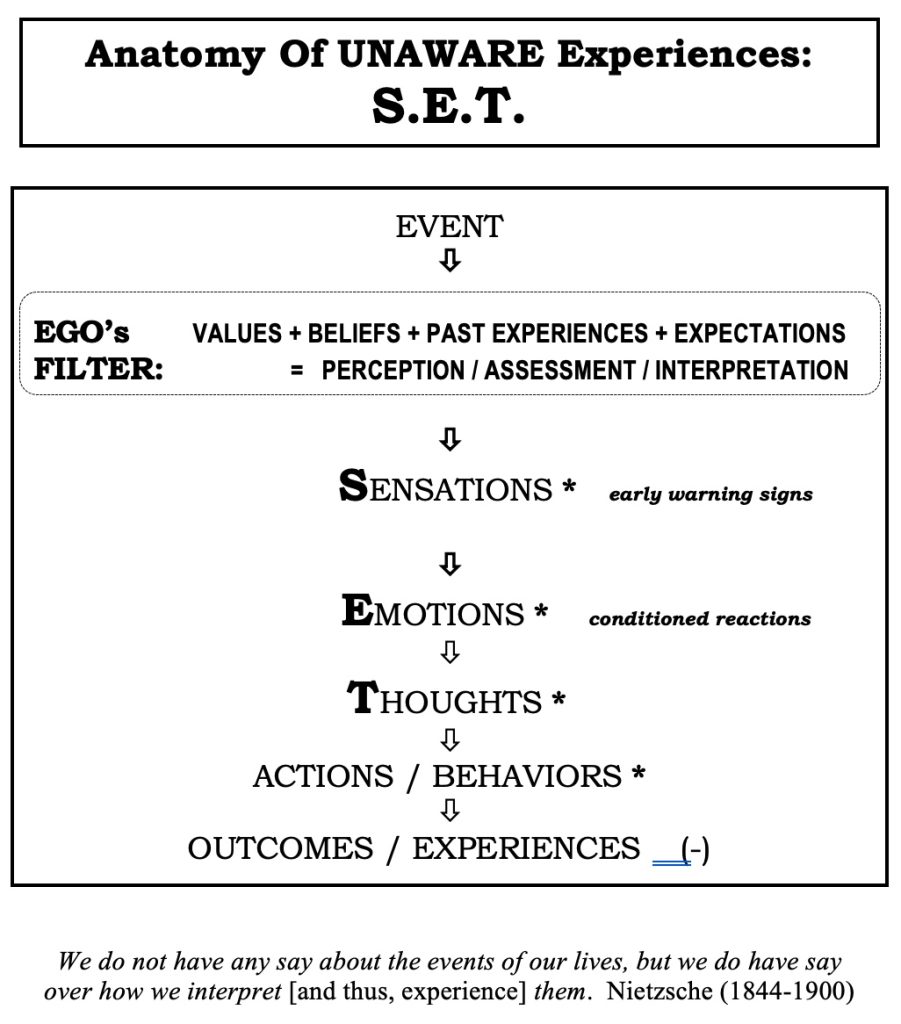
Philosopher and writer, Friedrich Nietzsche’s quote above reminds us that all we really have control over is how we choose to respond to life’s events. If we are unaware or not mindful of these events, in all likelihood, we react to them out of our past conditioning. In other words, the combination of our values, beliefs, past experiences, and expectations forms our perception of an event. If our perception is negative, our experience and outcomes are negative, and conversely, if our perception is positive, so are our experience and outcomes.
For instance, if you value peace and joy, you believe the world is a safe place, and your past experiences have shown this to be the case, then your perception is one of optimism, positivity, and hopefulness. This positive perception further influences your sensations, emotions, thoughts, and behaviours in the same direction. The result is that you experience positive outcomes.
On the other hand, if you value security and control, you believe that the worst will happen, and your past experiences support this, your interpretation of life’s events is more pessimistic, negative, and distrustful. All of which has a negative influence on your sensations, emotions, thoughts, and actions, eventually resulting in negative outcomes. Hence, the adage, perception is reality, and what we believe, we receive.
Yoga, science, and medicine agree that the more negativity we express, the more tension we create and experience, internally and externally. They also agree that it is much harder to change our negative outcomes by changing our negative behaviours. Think about addictions like overeating, smoking, and drug use. The good news is that becoming aware of our physical and energetic sensations allows us to intervene earlier in the evolution of our experiences. These “early warning” sensations enable us to respond positively in the moment before our fragile ego kicks in with its desires and cravings. Thus, the anatomy of your experience is transformed as illustrated below.
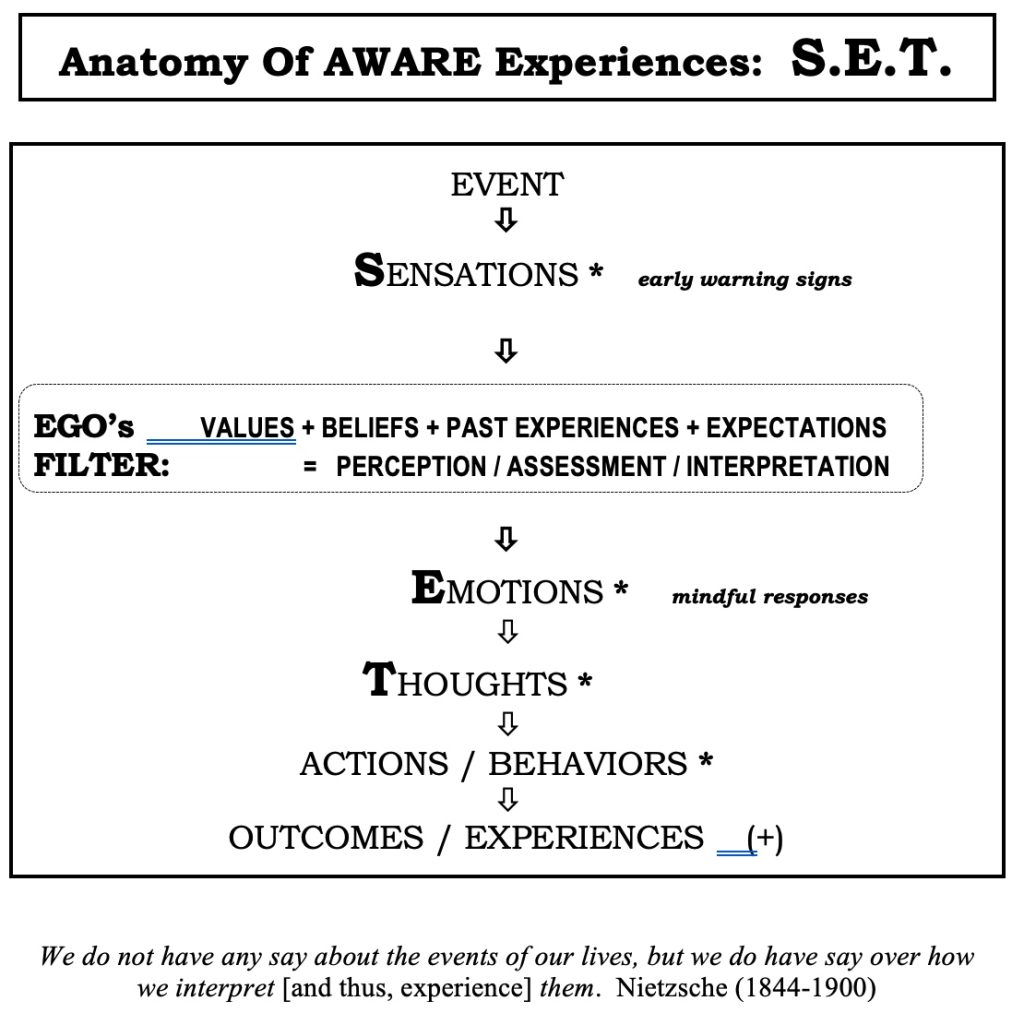
Your growing awareness begins to dissolve old negative reactions, relaxing tension in your body, emotions, and thoughts. You move from reacting with habitual, unserving patterns to responding mindfully with emotions, thoughts, and behaviours that evolve positive outcomes.
Remember, wherever you experience sensation in your body, there resides tension. This is your body’s early warning signal of something that needs your attention and awareness. Unattended sensations eventually trigger emotion and thought, culminating in the story you have woven as your assessment of an event. And so the circle of negative perception and karma continues.
Attending to where bodily sensation exists allows you to move your awareness deeper into your muscular and myofascial tissue as well as into your subtle energetic body or Pranamaya Kosha. This kosha, with the support of our breath, manages the movement of energy behind thoughts, emotions, and behaviours.
The seven myofascial bands in the body (see illustration below) accrue tension in all three layers of fascia —
1. Superficial Fascia: Located just beneath the skin within the hypodermis, this layer consists of fat and elastic fibers.
2. Deep Fascia: A dense, fibrous, and organized layer that surrounds muscles, bones, nerves, and blood vessels.
3. Visceral/Subserous Fascia: This layer wraps and suspends organs within their cavities (the heart, lungs, and abdominal organs).
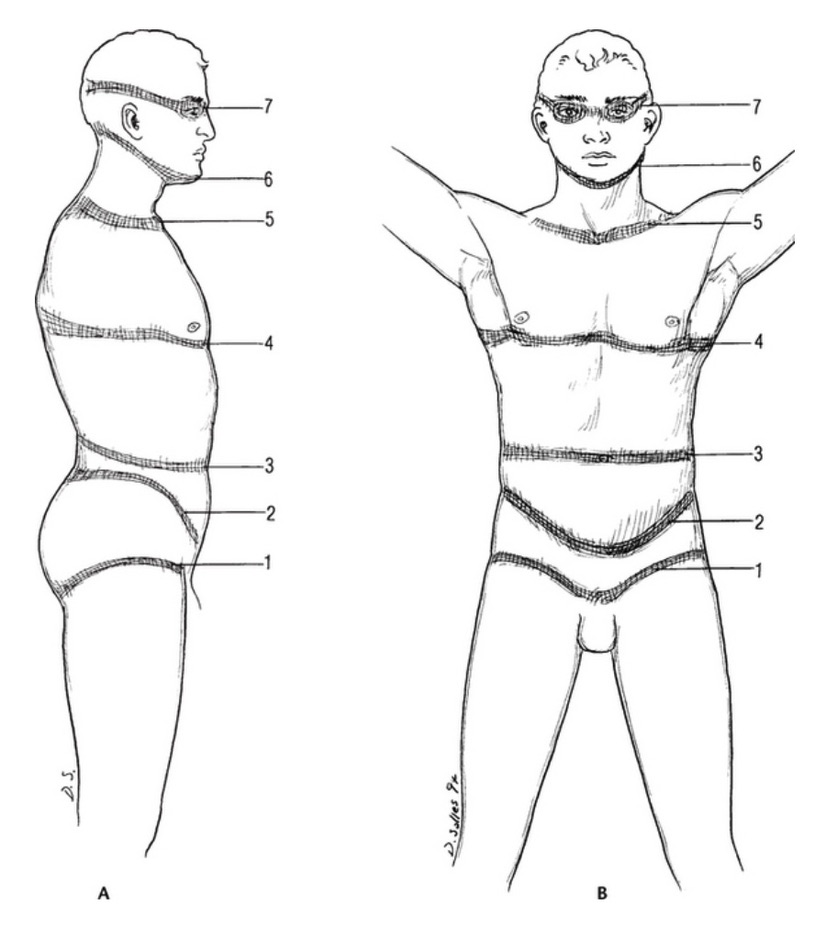
In previous blogs, we used our awareness and breath to unlock and relax tension in Bands 1 & 2 (pubic & inguinal) and Bands 3 & 4 (navel & diaphragm)
The fifth or Collar Bone band runs from the lumbar-C7 joint at the base of the neck (back body) along the upper shoulder blades through the shoulder joints to continue along the collar bones in the front body. The Collar Bone band and the Diaphragm band are the ceiling and floor, respectively, of the heart space, which is a major storehouse of unrepressed emotions. Thus, bringing greater relaxation and ease into both of these bands positively impacts our mental-emotional well-being while directly impacting the physical health of our heart.
Practice the following yoga actions during each of the asana shapes depicted below. Remember, creating ease with your awareness and breath, in the superficial and deep layers of your being, holistically transforms into positive outcomes.
YOGA ACTIONS:
1. With your awareness, find your C7-Thoracic joint in the back body.
2. Expand the space between these two vertebrae by gently inhaling into that space.
3. Keep that expanded space as you sense for tightness, numbness, or pain along the top edges of the shoulder blades into the shoulder joints. Relax any tension you come upon. Again, you might do this by gently breathing into that tension.
4. Take your awareness to your collar bones in the front body and sense from the sternal notch along the collar bones into the shoulder joints. Relax any tension you discover.
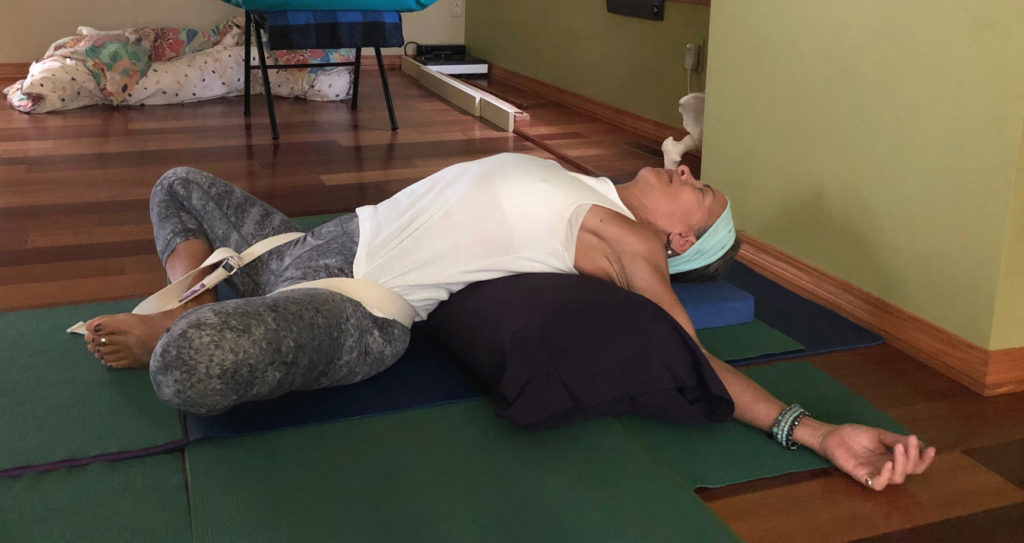
1. SUPTA BADDHA KONASANA 5 to 10 minutes
– horizontal bolster under thoracic spine
– armpits are free of the bolster
– support head if neck feels compressed
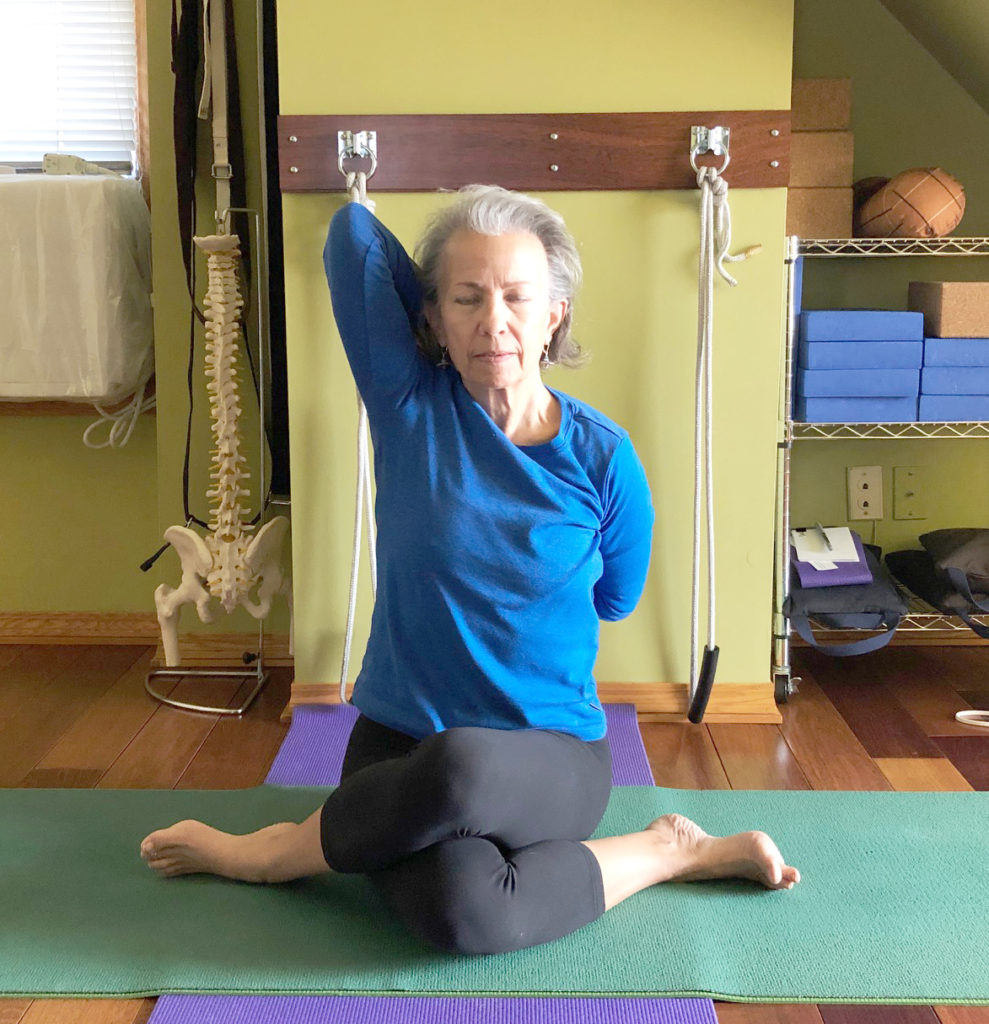
2. GOMUKHASANA 2 m each side
– clasp hands behind back or clasp a belt between hands
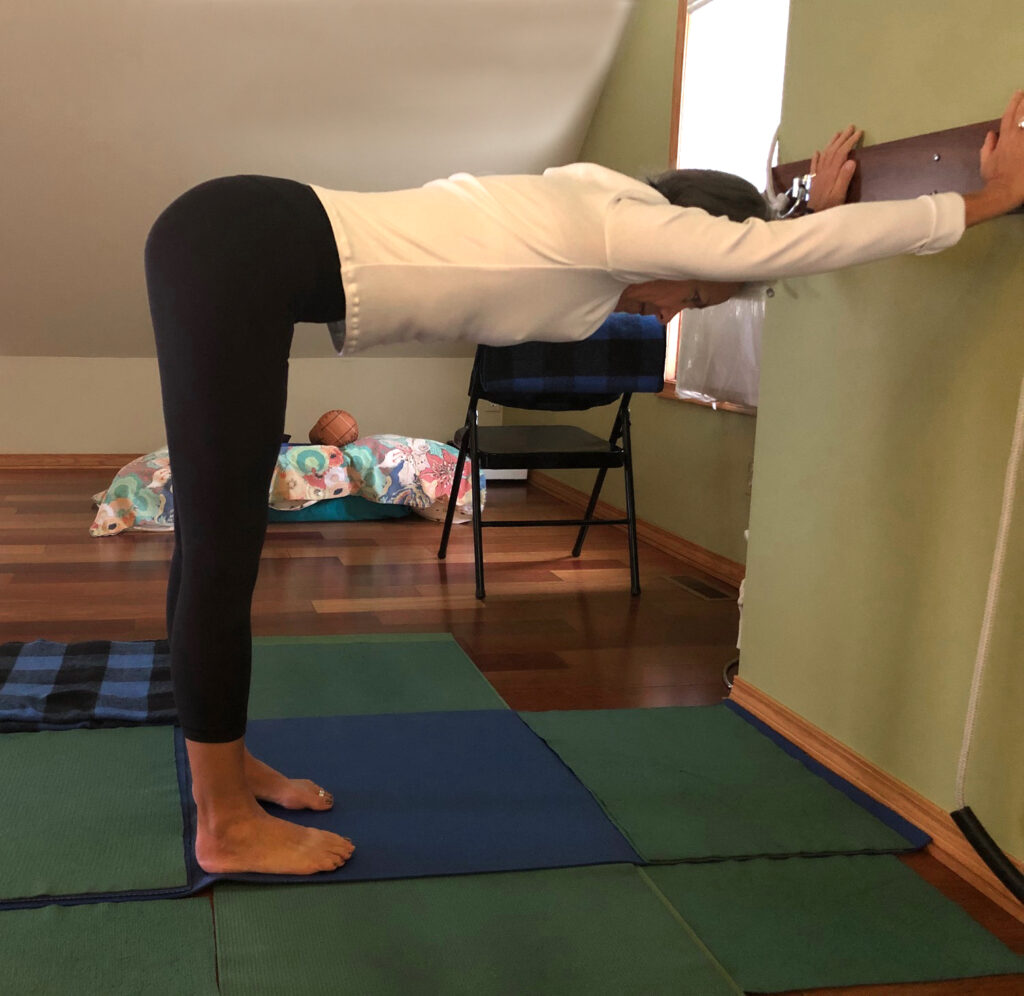
3. WALL STRETCH 1 minute
4. ADHO MUKHA SVANASANA to EKA PADA ADHO MUKHA SVANASANA 1 m ea variation
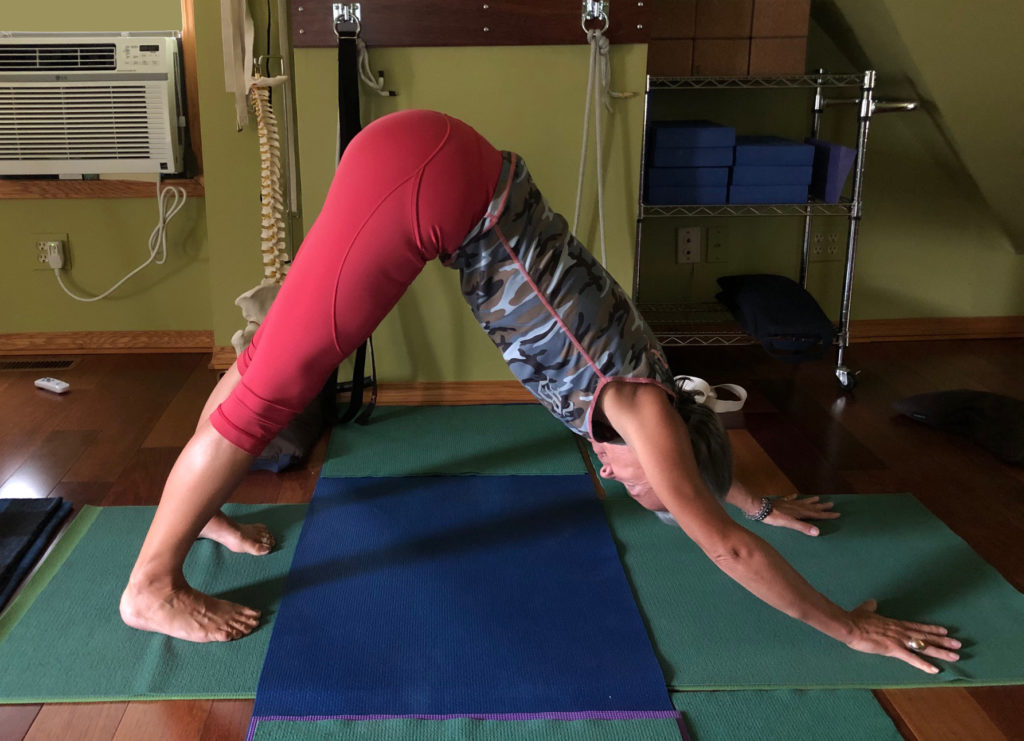
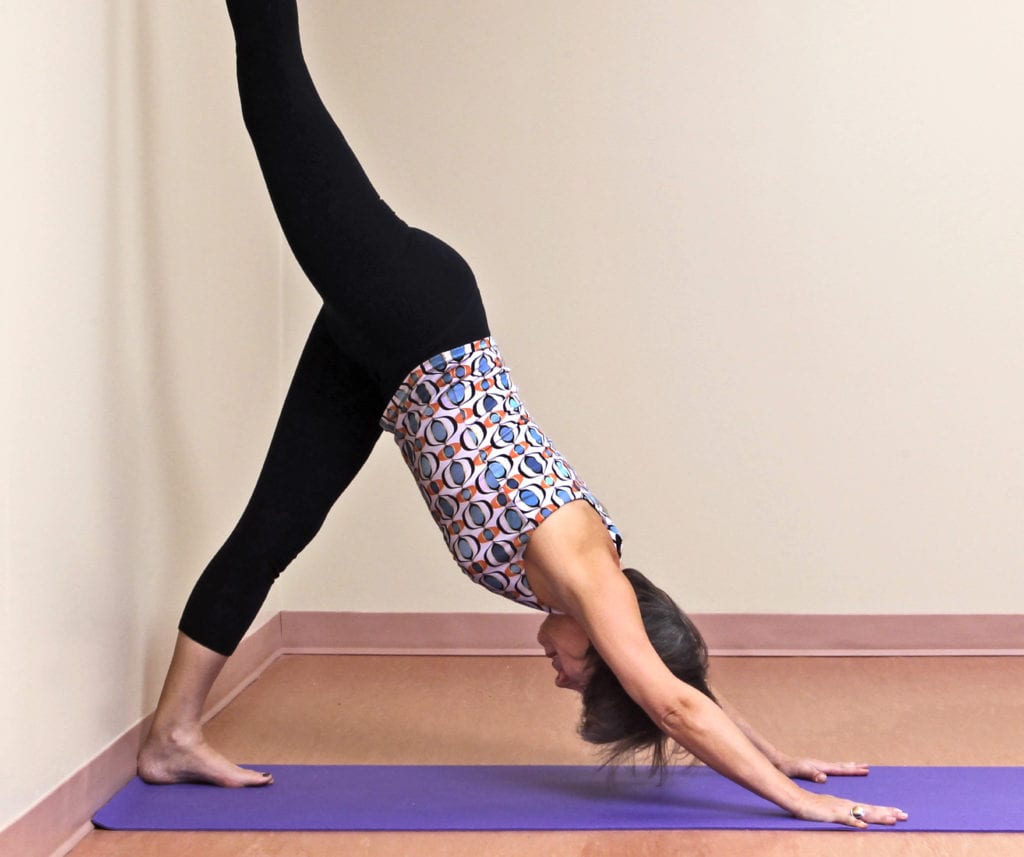
– extend upper heel away from crown of head.
5. SALAMBA URDHVA DHANURASANA 1 to 2 m
– stabilize chair by pressing heels into front legs; toe mounds remain on floor
– find middle of shoulder blades with chair back
– inhale, lift pelvis, and roll middle shoulder blades over chair back
– hands press into wall
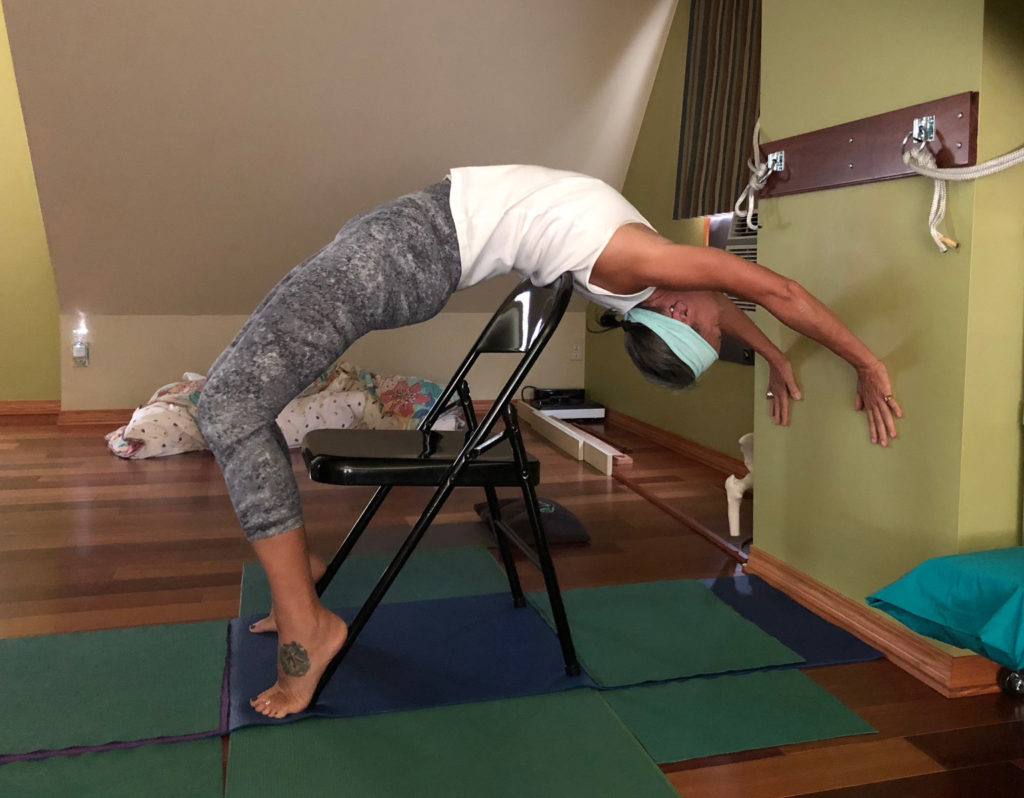
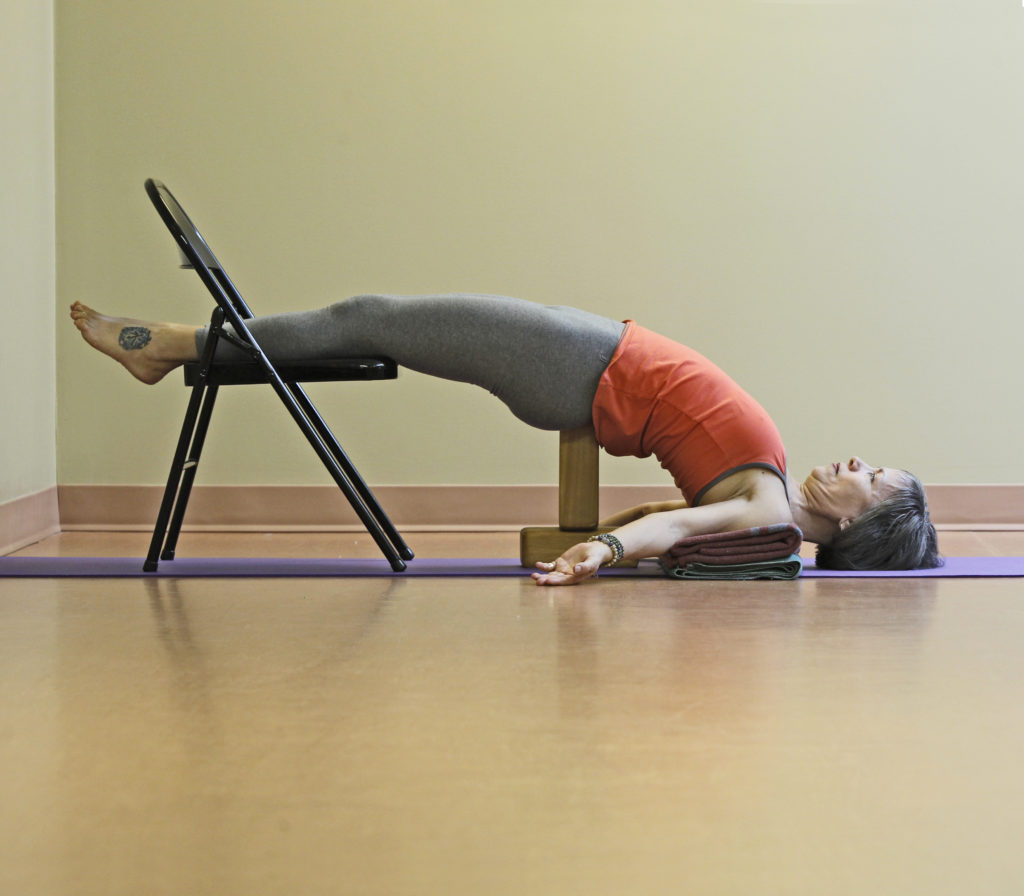
6. SALAMBA SETU BANDHA 3 to 5 m
– chair supports calves and knees
– 1 LO & 1 MED block under sacrum
– 2 double-folded blankets under shoulders
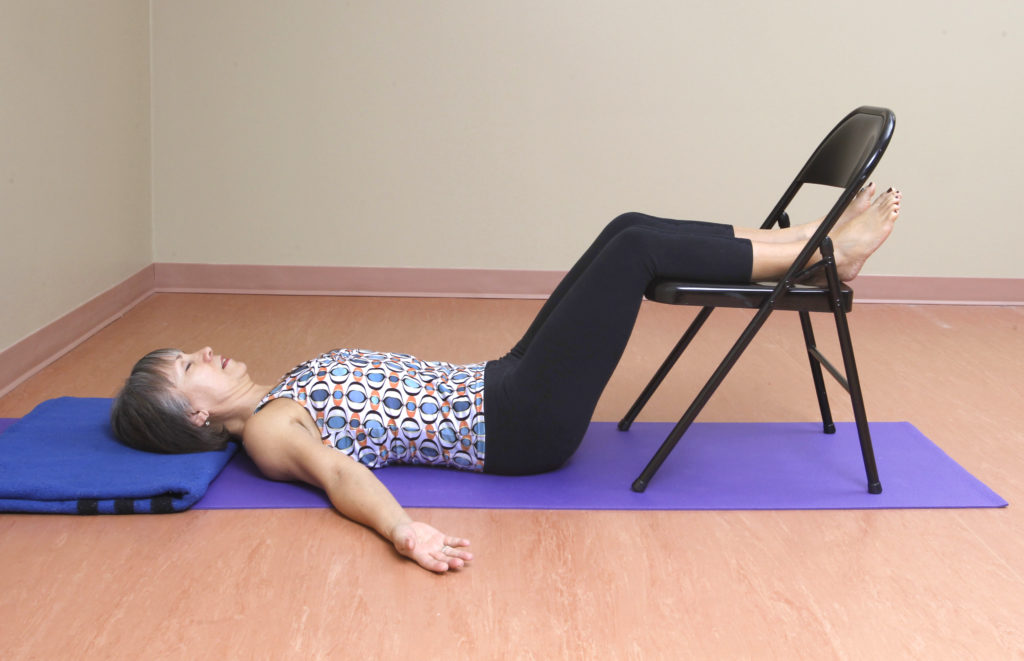
7. CALF-SUPPORTED SAVASANA 10 to 15 m
For more yoga actions and teachings, click here. Namaste.