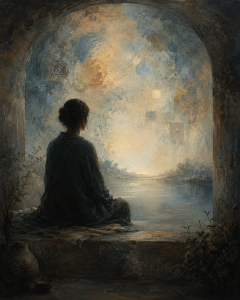
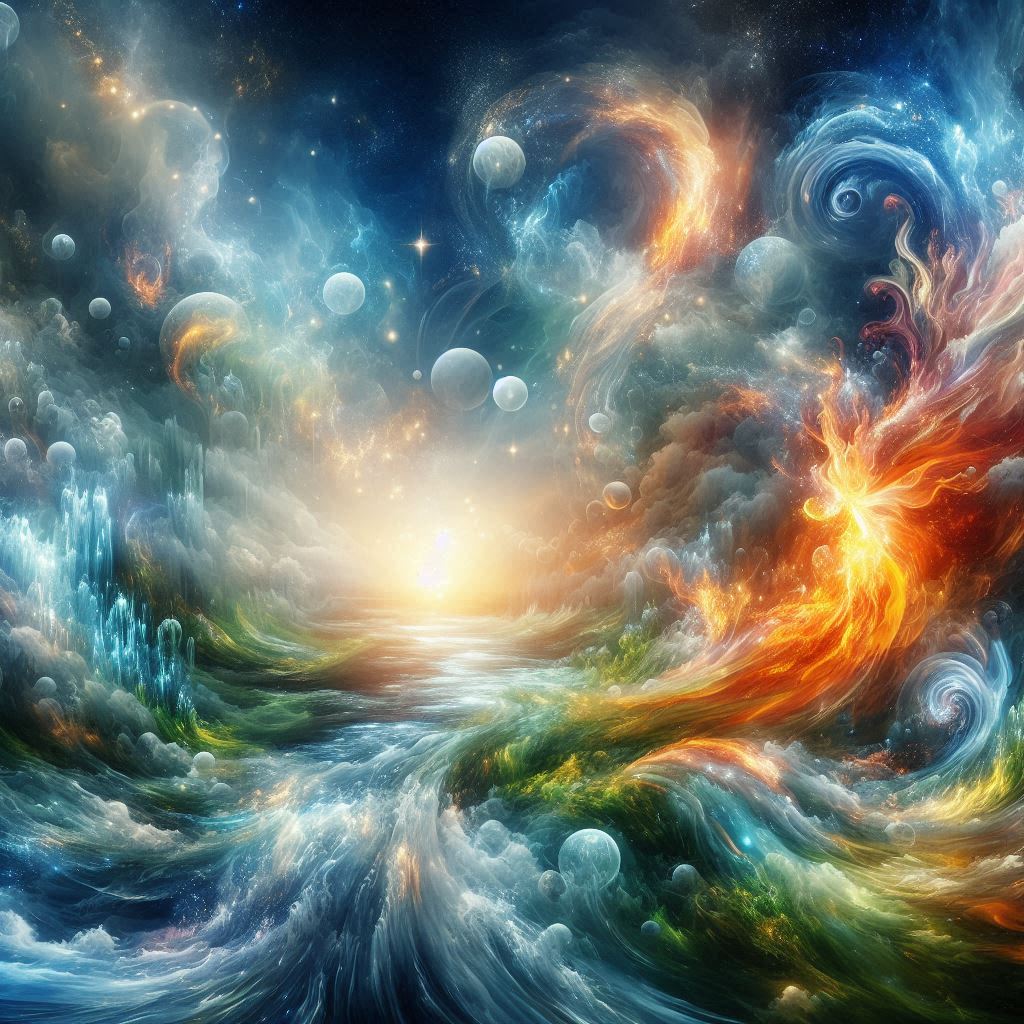
As the Upanishads teach us, everything is elemental and thus deemed sacred or holy. That which is sacred to life is defined as being a person or thing worthy of awe and respect or intended wholly for serving God. If the word God, triggers a negative reaction, then think in terms of serving good selflessly.
This does raise an interesting question for me: What or who is God in the Upanishads? God is referred to as Brahman and conceptualized as the Cosmic Principle with these key aspects —
- Ultimate Reality: the fundamental substance and essence of all things, the “primordial reality” that underlies the entire cosmos.
- Source of Existence: According to the Taittiriya Upanishad, Brahman is the source from which beings are born, the principle by which they live, and the entity into which they return upon death.
- Impersonal and Universal: Unlike a personal, anthropomorphic God, Brahman is generally seen as an impersonal, universal force that is beyond emotions, good and bad, and favoritism. It is the “absolute” and “universal” force behind everything.
In the Upanishads, Brahman has been variously described as Sat-chit-ananda (always true–always aware–always joyful), and as the unchanging, permanent, highest reality, and as the Lord of Love. As you will read in the following verse from the Taittiriya Upanishad 7.1, Brahman is also described as everything elemental.
Earth, sky, worlds above, quarters and their halves;
Fire, air, sun moon, and stars; water, herbs, trees,
Space, and entity are the elements.
Eye, ear, mind, tongue, and touch; skin, flesh, muscle,
Marrow, and skeleton; and the five
Vital forces [prana] constitute the body.
The sage, contemplating these sets of five,
Discovered that everything is holy.
Wo/Man can complete the inner with the outer.
The provided text identifies five groups of elements that make up the universe and the human body: the external world, celestial bodies, natural elements, sensory organs and body parts, and the vital forces. By contemplating these five sets of five, the sages discovered a profound truth: all of existence is holy, and humans can achieve spiritual completeness by connecting their inner selves with the outer world.
The universe and the human body as interconnected wholes —
- External world: Earth, sky, worlds above, the four cardinal directions and their halves.
- Celestial bodies: Fire, air, sun, moon, and stars.
- Natural elements: Water, herbs, trees, space, and entity (spirit or life force).
- Body parts: Eye, ear, mind, tongue, and touch;
Skin, flesh, muscle, marrow, and skeleton. - Vital forces: The five Pancha Vayus: Prana, Apana, Samana, Udana, and Vyana.
The discovery of holiness —
- The sage recognized that the universe and the body are not separate but are composed of the same five-fold elements.
- This understanding led to the realization that everything is holy, or sacred.
The path to spiritual completeness —
- By understanding this connection between the inner and outer, a person can realize the sacredness of all existence. The text concludes that a person can achieve spiritual wholeness or completion by integrating their inner self with the external world. Although this is a complex undertaking, it can also be as simple as aligning oneself with the seasons — Fall (changing, reflecting), Winter (hibernating, ending), Spring (new beginnings), and Summer (passion, growth).
For more yoga actions and teachings, click here. Namaste.