
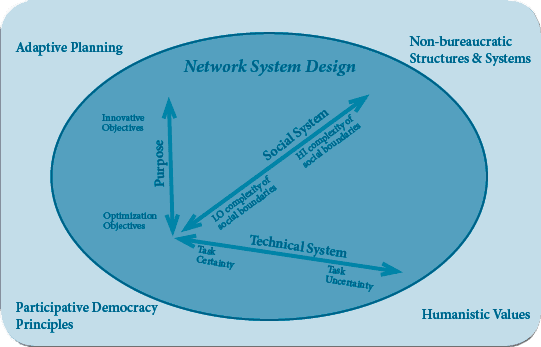
Co-authors of this post on the Adaptive Enterprise are STS-RT Discovery Team members: Doug Austrom, Don de Guerre, Bob Laliberte, Helen Maupin, Bernard Mohr and Carolyn Ordowich.
Our problem is not the complexity of our models but the far greater complexity of a world economy whose underlying linkages appear to be in a continual state of flux. The continuity of emergent structure derives not from stability but from adaptability. Alan Greenspan
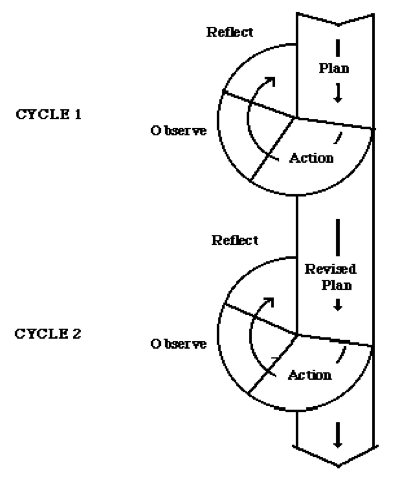
Since 2004, the Discovery Team (the Research & Development arm of the Socio-technical Systems (STS) Roundtable) has engaged in a multi-stakeholder action research process. Action research or “learning-by-doing” is a co-learning process where a group of people attempts to
“. . . contribute both to the practical concerns of people in an immediate problematic situation and to further the goals of social science simultaneously. . . . [This] dual commitment . . . to study a system and concurrently to collaborate with members of the system in changing it . . . requires the active collaboration of researcher and client, and thus it stresses the importance of co-learning as a primary aspect of the research process.”*
The figure below illustrates a simple action research process through which STS practitioners engage with their clients in attempting organizational transformation. Although only two cycles are depicted here, this process is a series of continuous learning loops in which learning is never complete.
The Adaptive Enterprise: Asking Questions
This action research process is being utilized by the STS-Roundtable Discovery Team, within its practitioner community, to ask and answer the following questions —
- What has historically been the STS value proposition (i.e., our unique offering with respect to cost and benefit)?
- What new forms of organizing are emerging in the world (i.e., the new context for our work as STS organization design practitioners)?
- How do we now articulate our value proposition in the new context of the 21st century?
- What are the implications of the above for STS design principles, values and processes?
To date, the STS Roundtable’s journey of discovery is built upon the following assumptions and beliefs about the guiding theory and tenets of our field of practice as STS Designers.
- STS theory states that all organizations are:
- open systems and as such need to continuously renew and adapt to the opportunities and demands in the environment.
- socio-technical systems which function more humanely and effectively when these systems are jointly optimized.
- STS theory led to the following value proposition offered by most STS practitioners to clients:
- “We create and enable highly participative processes focused on:
- building a business strategy that both responds to and influences the environment.
- designing work organizations that jointly optimize their social and technical systems to deliver on the aligned business strategy.
- designing, with intent, a high quality of working life for all members.
. . . which together accelerate the movement toward workplaces and lifespaces that work well and are good to work and live in.”
The research and development by the STS-Roundtable led to the following six discoveries:
- The need for continuous and rapid adaptation (i.e., flexibility of work systems) has increased exponentially.
- “Member” alienation (isolation, lack of engagement) continues to be a key issue compounded by a new context of significantly greater complexity and pace of change in the environment.
- Issues of coordination within and among the parts of an enterprise continue to be a key issue, again compounded by greater complexity and pace of change.
- The intentional use of socio-technical networks is becoming more prevalent as a means to achieve cost efficiencies, requisite flexibility and mutual adaptation.
- New design processes and technologies for meaningful participation are required in both the design and ongoing governance of the organization. (i.e., Design Thinking, Appreciative Inquiry)
- Three observable new forms of organization (see Adaptive Enterprises below) are evolving at the local, regional, national, and global levels in response to the need for flexibility/adaptation.
Three Emerging Forms of Adaptive Enterprise:
- Vertically-integrated Decentralized organization (VIDO)
- Value realization network (VRN)
- Issue-based eco-system (IBES)
Note: for an earlier iteration and description of these adaptive enterprises.
These three forms describe what we, as STS design practitioners, are seeing. We are not prescribing them as ideal organization forms. They are the new “contexts” within which people currently work and in which we have the opportunity to “design.”
At this point in its discovery process, the STS Roundtable Discovery Team proposes:
- each of these three forms of organization is an attempt at being “adaptive enterprises” (some more successfully than others)
- most existing organizations are VIDO’s (to some extent)
- all VIDO’s have the potential to be part of VRN’s and IBES’s
- these three organizational forms fall on a learning and growth curve — moving from VIDO to VRN to IBES
These three emerging forms of organization present demands and opportunities for all organization design practitioners. However, from the perspective of STS tools, values and methods, participatively and jointly optimizing technical and social systems (versus only maximizing the technical system) would be helpful to —
- VIDO’s working on process redesign to build effective internal supply networks among their decentralized parts with ownership retained by one enterprise
- VRN’s working with multiple partners on shared mutual gain/outcomes with shared ownership
- IBES’s deliberations for building shared sense-making and commitment to resolving an issue that impacts all members (climate change, etc.)
From a personal perspective, which of the forms have you experienced in your work life? What design elements for coordinating information and interactions brought you success?
In my July 2011 blog, Emerging Organization Designs – Part I: Models of Form, I wrote about how strategy shapes organizational design. Jay Galbraith (1995) furthers understanding of the organizational design process by stating “organizational design decisions are the shapers of the organization’s decision process.” To summarize, different organizational strategies require different organizational designs or structures.
A quick read of July’s blog will refresh your memory of three emerging organizational structures we are seeing in today’s marketplace, but what do we mean by organizational strategy and how does it fit in this framework? I am not surprised if it seems confusing, as no real agreement exists in the business literature on a concise definition of organizational strategy.
Depending on which business author you favour reading, strategy is defined as:
- maneuvering into position (foresight and knowing what to do)
- fulfillment of policies and plans to create advantage
- a means (policies) to clear and visible ends (goals)
- directional decisions (purpose, mission) and actions (deployment of resources)
- a focused perspective (single driving force, clear core values)
- differentiating oneself in the customers’ eyes (competitive position, uniqueness)
- choosing a value discipline (customer intimacy, operational excellence, product leadership)
For the sake of brevity, understanding, and the purposes of this blog, I coupled together the following definition:
Strategy is a perspective, position, and plan realized over time through a pattern of decisions and actions (Henry Mintzberg) that differentiate and deliver a unique mix of value (Michael Porter) to the customer.
Regardless, if one’s analysis of strategy crosses a broader view, for an enterprise’s business strategy to be successful, it must differentiate and deliver value from its customers’ perspective. What is implied here is clarity on and appreciation for what distinguishes the enterprise from all others. With this enterprise awareness of its uniqueness and of current customer demand to optimize operational excellence and innovation simultaneously, it follows that structures and systems are required to enable and coordinate decision-making.
In a hierarchical, centralized structure (figure left below), each level in the organization has different roles, responsibilities, and decisions associated with it. Typically, strategy is the purview of the senior management team (CEOs and VPs) and seeks to answer “What?” — What business are we in? What assumptions do we hold? What global trends are impacting us? What are our goals – growth? excellence? profit? innovation?
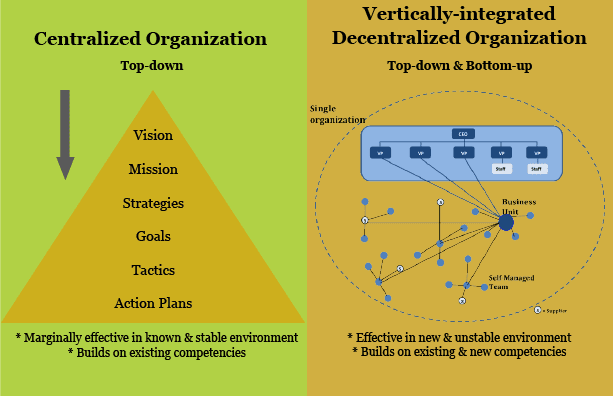
As we move down the corporate ladder, tactics or ‘how tos’ become the focus point for deciding how the organization will achieve its strategic direction. In an economic environment of greater certainty (predictability) and stability (slower rates of change), the centralized hierarchy has proven effective in mastering scale and operational efficiencies. However, as the workforce became increasingly more educated and evolved into knowledge workers, dissatisfaction with command-and-control structures (limited opportunity for meaningful work and involvement in decision-making) increased. In addition, as our business environment increased in complexity, unpredictability, and speed, the traditional hierarchy’s ability to agilely coordinate decision-making decreased.
In an environment where the ‘unknowns’ and complexities are considerable, and the speed of change and innovation is accelerated, strategic and tactical decisions must not only occur at a much faster pace but must include more people. Network organization structures — the vertically-integrated decentralized organization — have emerged in response to these new, unstable environments, which require business strategies to jointly optimize organizational efficiency and organizational innovation. While the hierarchy is best suited to optimize and standardize efficiencies, the network of self-managed teams best supports rapid innovation — two different structures for two different strategies.
In past decades, these two different structures would have existed in two separate organizations. Today, the efficiency hierarchy and the innovation networks exist in the same organization — two different structures for two different strategies within one enterprise. With two different leadership styles, two different decision-making processes, two different work systems, and two different cultures all living under one ‘roof’, the potential for conflict and chaos is enormous. At the very least, in this kind of complexity, leading and managing require a calm, collaborative disposition.
I am curious about your own enterprise or employer. Are you/they strategizing for efficiency as well as innovation? Do your structures reflect these dual needs? Is your leadership able to support this duality?
The synergy of changing values and economic necessity is transforming capitalism.
Patricia Aburdene, Megatrends 2010
When American futurist Patricia Aburdene wrote this passage, she was forecasting the dawning of a new economic era. Just as the Industrial Age gave way to the Information Age during the late 70s and early 80s, a new era of interaction and innovation is supplanting the information economy. Although Aburdene calls this new era of social transformation the Economy of Consciousness, other names have also surfaced as identifiers—Collaboration, Innovation, Interaction. Regardless of these different labels, what is held in common are this era’s characteristics:
- global social systems change (political and economic)
- economic necessity
- value-driven trends
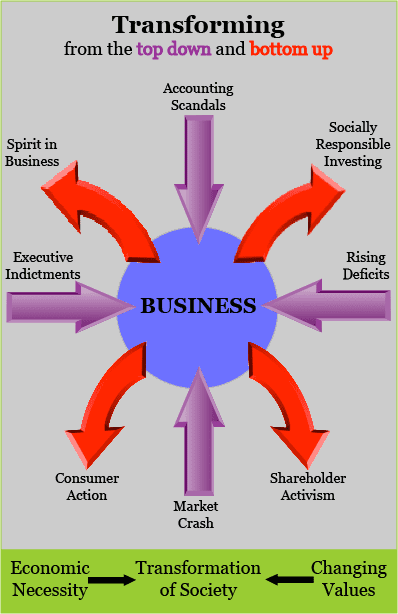
In the cross-border business world, government deficits, escalating energy and healthcare costs, recessions and recent market crashes, and executive greed and indictments symbolize a crumbling social order predicated with insecurity, uncertainty and mistrust. In the face of all this bad news, the good news is the search for new solutions has triggered a reinvention of capitalism and social democracy led by a shift in values. When human society begins to shift its values, we are manifesting evolutionary growth or a raising of our consciousness. In other words, our discovery that the old ways of being (i.e., capitalism, communism, social democracy) no longer serve us, opens us up for new possibilities.
Aburdene’s foremost new possibility or “megatrend”—the power of spirituality—necessitates at its core a changing value set. These new values emerge from inquiry or looking within to understand and create added value. The list of 30 values below allows you to look within and discover what you hold as valuable. Because your values drive your behaviour, you are in essence bringing awareness to your personal brand.
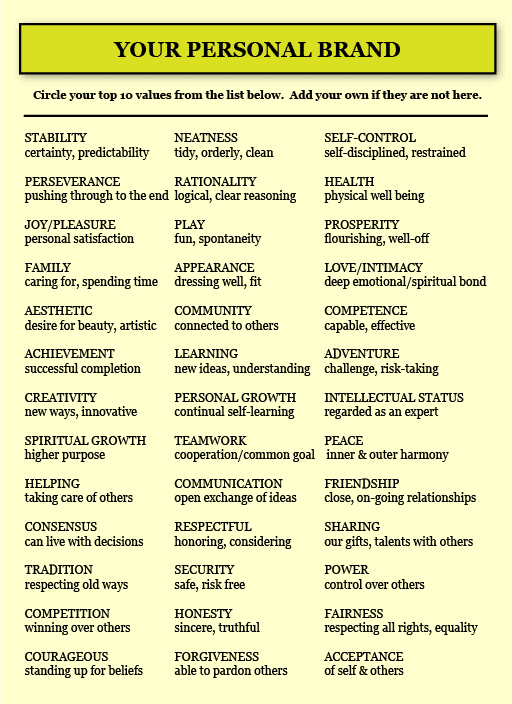
Once you have chosen 10, reduce your list to your top 5. Then once more reduce it to 3. These final three values are CORE TO WHO YOU ARE (your personal brand).
The next time you need to make a decision, ask yourself whether each decision supports the three values you chose — Will this bring me peace? … love? … joy? Only when you can answer ‘yes’ to all three queries should you follow through on your decision.
How closely do your core values align with the Adaptive Enterprise’s draft list of values below?
- Community (dialogue, inclusion)
- Nurturance (meaning, growth-based participation)
- Humanity (dignity, spirituality)
- Beauty (collective creativity, participative democracy)
Sources:
- Aburdene, Patricia. 2005. Megatrends 2010: The Rise of Conscious Capitalism, Hampton Roads Publishing Co., Inc., VA.
- STS-RT Discovery Sub-Team (Doug Austrom, Don De Guerre, Bob Laliberte, Helen Maupin, Bernard Mohr and Carolyn Ordowich). 2011. “Designing the Adaptive Enterprise.” Presentation at New Orleans Annual Meeting, September 28th to October 1st.
- Galbraith, Jay R. 1995. Designing Organizations: An Executive Briefing on Strategy, Structure and Process, San Francisco: Jossey-Bass.
- Mintzberg, Henry. 1994. The Rise and Fall of Strategic Planning, Basic Books.
- Porter, Michael. 1996. “What is Strategy?” Harvard Business Review (Nov-Dec).
- Porter, Michael. 1986. Competitive Strategy, Harvard Business School Press.
- STS-RT Discovery Team. 2011. “Designing the Adaptive Enterprise.” Presentation at New Orleans Annual Meeting, September.
- *Thomas Gilmore, Jim Krantz and Rafael Ramirez, “Action Based Modes of Inquiry and the Host-Researcher Relationship,” Consultation 5.3 (Fall 1986): 161.
- **Dan MacIsaac, “An Introduction to Action Research,” 1995, http://www.phy.nau.edu/~danmac/actionrsch.html (22/03/1998).